


⏱ 9 min read
The nunchi (눈치) is finally here — and once you understand it, you start noticing it everywhere.
There is a word in Korean that has no perfect English equivalent.
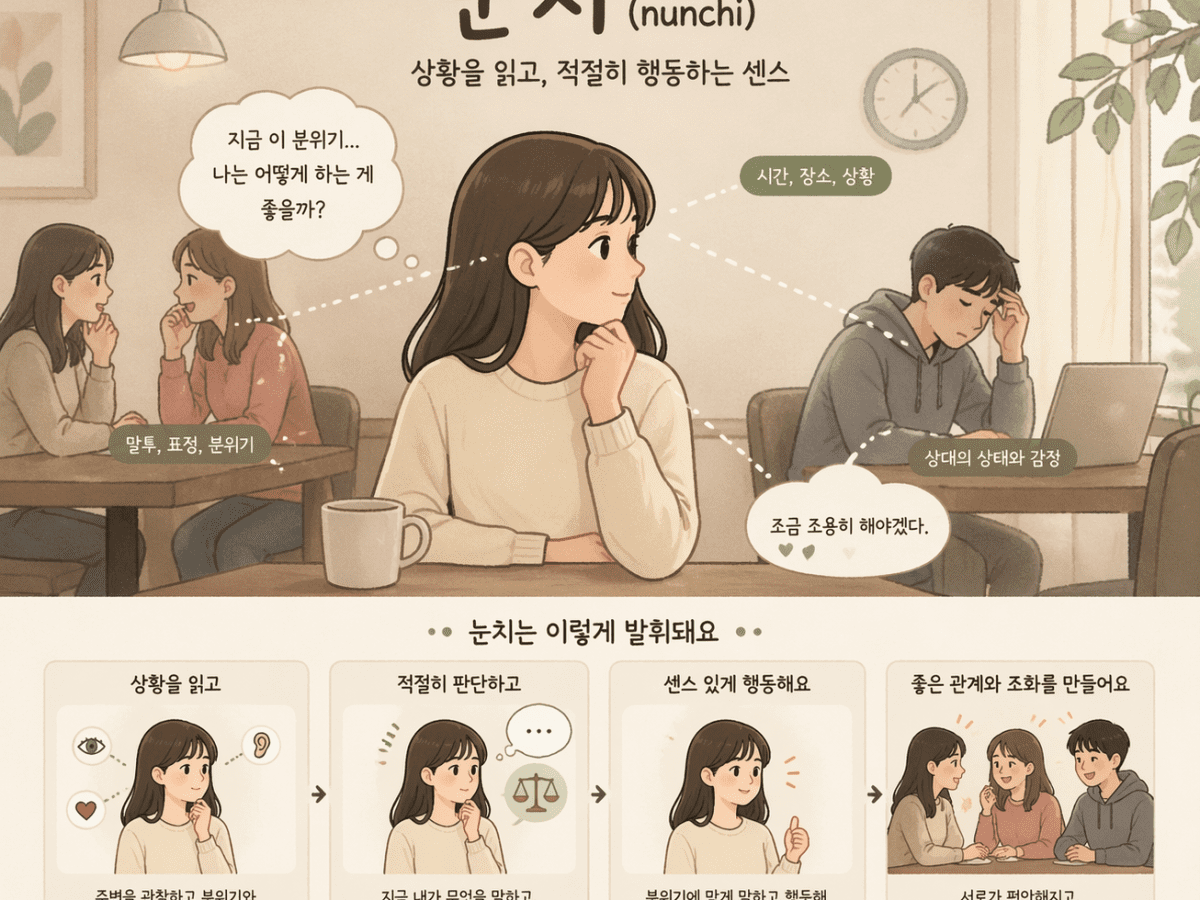
It describes reading a room, sensing the mood, and knowing what to do without being told.
That word is 눈치 (nunchi).
And once you learn it — you can’t unsee it.
What Nunchi (눈치) Means
At its simplest, nunchi (눈치) means the ability to understand a situation or someone’s feelings without explicit communication.
But that definition is too small.
It’s not just understanding. It’s reacting correctly.
In Korean, you don’t always say what you mean directly. That means people rely on subtle cues — tone, silence, timing, body language.
Nunchi is the skill that lets you read all of that.
Here’s the difference:
- Empathy → feeling what others feel
- Nunchi → knowing what to do about it
That’s the “aha” moment.
Nunchi is action, not just emotion.
Where Nunchi (눈치) Comes From
The word itself gives a clue.
눈 (nun) means “eye.” 치 (chi) means “measure.”
Together, it means “measuring with your eyes.”
Not just seeing — but interpreting.
This reflects something deeper about Korean communication.
In many Western cultures, clarity is valued. Say what you mean.
In Korean culture, harmony often matters more than directness.
That means meaning lives between the lines.
Nunchi is how you find it.
How Koreans Actually Use Nunchi (눈치)
You don’t learn nunchi (눈치) from a textbook.
You learn it by watching people.
You hear it in everyday expressions:
- 눈치가 빠르다 (nunchi-ga ppareuda) → “quick nunchi” (good)
- 눈치가 없다 (nunchi-ga eopda) → “no nunchi” (bad)
- 눈치를 보다 (nunchireul boda) → “to read the room”
And you see it constantly.
At a Korean dinner table:
Someone refills your drink before you ask.
That’s nunchi.
In a meeting:
No one interrupts the senior speaker.
That’s nunchi.
In a K-drama:
The character who senses tension before anyone speaks?
That’s nunchi.
You need it everywhere.
Especially when nothing is being said.
Why Nunchi (눈치) Has No English Equivalent
English has words like “intuition,” “tact,” and “emotional intelligence.”
None of them fully capture nunchi (눈치).
Because those words describe awareness.
Nunchi includes responsibility.
In Korean culture, noticing something isn’t enough.
You are expected to adjust your behavior.
That’s the key difference.
In English:
You can read the room — and ignore it.
In Korean:
You read the room — and act accordingly.
That’s why translation fails.
Because the concept itself is different.
How To Use Nunchi (눈치) Yourself
You don’t need to be Korean to use nunchi (눈치).
You just need to slow down.
Start with simple habits:
- Pause before speaking
- Watch how others react
- Notice silence — not just words
Then try using these phrases:
- 눈치 좀 있어라 → “Have some awareness”
- 눈치 빠르네요 → “You catch on quickly”
But the real skill isn’t language.
It’s attention.
Because nunchi isn’t about guessing.
It’s about noticing.
📌 You might also enjoy:
→ Jeong (정): The Korean feeling you can’t translate
→ Han (한): Korea’s deepest emotional concept explained
→ Why Korean honorifics change everything
Frequently Asked Questions
What is nunchi (눈치)?
Nunchi is the Korean ability to understand situations and emotions without being told, and to act appropriately based on that understanding.
Why is nunchi (눈치) important in Korea?
Because communication is often indirect, and social harmony depends on understanding unspoken cues and adjusting behavior.
Can foreigners learn nunchi (눈치)?
Yes. It is not about language fluency but about observation, awareness, and sensitivity to social context.
Korean isn’t just a language.
It’s a different way of seeing the world.
And it starts with one word.
If you’re new to K-pop, this is the perfect moment to start exploring.