


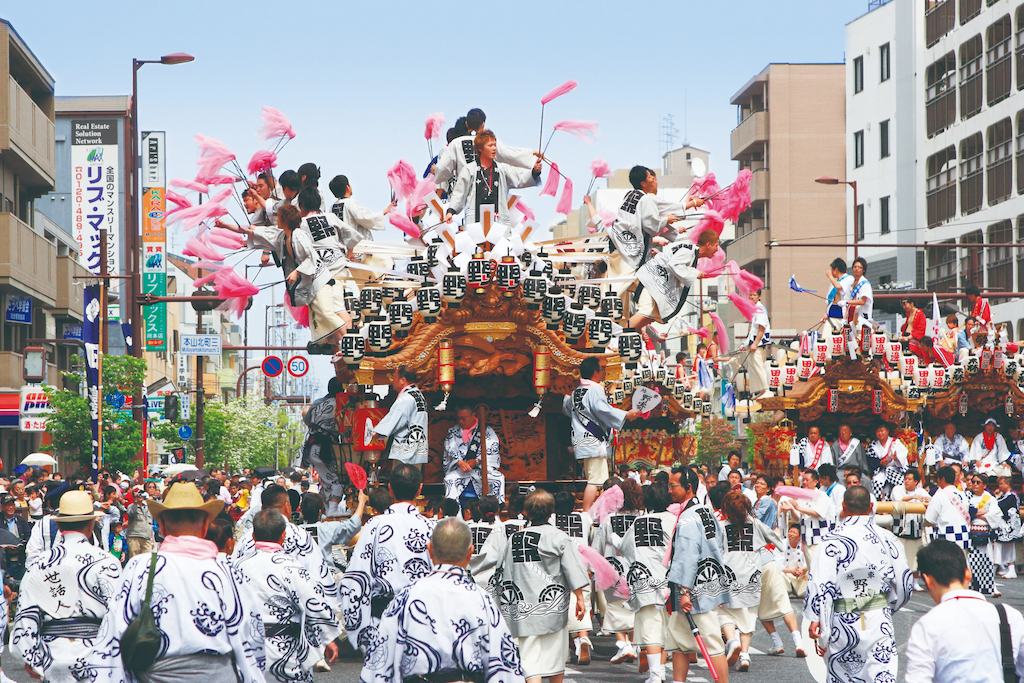
Danjiri Festival doesn’t feel like a quiet local ritual for long. The first thing you notice is movement: a wooden float surging forward, ropes tightening, shoes scraping against stone, and a drumbeat that seems to come from the street itself.
That is what makes this festival hard to forget. It is not just “traditional” in the museum sense. It is loud, fast, and full of nerve. You can feel the heat of the crowd, hear the shout of the pullers, and see the carved wood and lantern light flash past in a way that stops you in your tracks.
As someone born in Korea, I keep thinking about how rare it is to see a regional custom survive with this much pride. The part that stayed with me most was not only the danger, but the care behind it: young locals working hard to keep something their town still claims as its own. That kind of scene is unforgettable.
And there is one detail that anchors the whole thing: the float does not look like a souvenir. It looks like a living object, built to move, painted to be seen, and carried by people who know exactly what it means to them.
:contentReference[oaicite:0]{index=0}
Quick Answer: Danjiri Festival began in the early 1700s as a harvest prayer in Kishiwada, Osaka, and it has grown into one of Japan’s most dramatic street festivals. The floats are pulled at speed through narrow roads, which is why people talk about the risk, the noise, and the thrill in the same breath.
⏱ 8 min read
Danjiri Festival: What It Is
Danjiri Festival is the famous Kishiwada festival where giant wooden floats are pulled through the city by teams of local residents. According to Kishiwada City, the festival dates back to 1703, when the lord of Kishiwada held an Inari festival to pray for a rich harvest. The city also describes the event as something that has been passed down for more than 300 years, shaped by the people of the town itself. :contentReference[oaicite:1]{index=1}
That history matters because it changes the way you look at the chaos. What seems wild today began as a prayer for rice, wheat, beans, millet, and a good season. The modern version is still tied to local pride, and Kishiwada City says the festival’s core spirit has always connected the community, even as society changed around it. :contentReference[oaicite:2]{index=2}
Why it stands out:
- The floats are huge, carved, and made to be seen up close.
- The pulling is fast, loud, and highly coordinated.
- The mood shifts from ritual to raw street energy in seconds.
The visual contrast is part of the appeal. Kishiwada City’s own description emphasizes the delicate and powerful movement in daylight, then the lantern-lit beauty of the floats at night. That switch from polished craft to full-speed street theater is the reason the festival feels so alive. :contentReference[oaicite:3]{index=3}
When people ask what Danjiri Festival “is,” the simplest answer is this: it is a harvest ritual that never stayed small. It grew teeth, sound, and speed, but it did not lose its local heart.
Why Koreans Keep Watching It Differently
Save this list — you’ll thank yourself later. 📌
For me, the festival lands in a very specific place between admiration and disbelief. I know what it looks like when a community protects a local event because it still means something. That is why the younger crews in Kishiwada stood out to me. They do not look like performers waiting for applause. They look like people carrying a town’s memory with their own hands.
There is also something deeply familiar about that tension between pride and pressure. In Korea, many regional events have been flattened into travel content, but Danjiri Festival still feels like it belongs first to the people who live there. That is what makes the scene so striking: the street is open to visitors, but the meaning is still owned at home.
What also caught me was the physical force of it. It looked so intense that I flinched a little, but I could not look away. The ropes, the shouting, the stamp of feet, and the sudden burst of speed all create the kind of moment that makes your chest tighten for a second. The energy is not polished. That is exactly why it feels alive.
Watch the shoulders, not just the float
The real story is in the bodies moving together: the strain, the rhythm, and the quick correction when the float shifts.
Notice the rooftops and upper lines
The drumming and movement above street level add another layer, and that is where the festival starts to feel theatrical.
Look for the old-town details
The narrow streets, worn pavement, and lantern light make the whole thing feel rooted in place, not staged for a camera.
If you only see danger, you miss the larger picture. The festival is also a public act of care. People train, practice, and return because the town keeps asking them to. That is what made the rooftops and the drum sound stay with me the most. It was a little shocking, but also strangely comforting.
How to Read the Festival Without Missing the Point
What Danjiri Festival asks from a visitor is simple: do not reduce it to a stunt. The speed is real, and so is the risk, but Kishiwada City frames the event as a tradition that has lasted because people keep choosing it, not because it is easy. That means the best way to understand it is to watch the discipline underneath the noise. :contentReference[oaicite:4]{index=4}
What to look for:
- The way the team moves as one unit.
- The carving, paint, and lantern work on the float.
- The shift from quiet waiting to sudden motion.
The museum side of the story also helps. Kishiwada City says the Danjiri Hall exists to present the festival’s history, sound, decorations, and spirit through displays and immersive media. That matters because it shows how the town treats the festival: not as a one-day show, but as a heritage worth preserving in more than one form. :contentReference[oaicite:5]{index=5}
When you see both sides together, the meaning gets clearer. The street event gives you the rush. The hall gives you the frame. Between them, you get the whole picture.
Danjiri Festival: What People Often Get Wrong
Many outsiders look at the festival and call it reckless first. That reaction is understandable. The floats are heavy, the corners are tight, and the pace is relentless. But that reading misses the fact that the town has built layers of practice around the event for generations. It is not random danger. It is controlled commitment.
Another mistake is to think the festival is only about spectacle for visitors. Kishiwada City’s own history page says the festival began as a harvest prayer and still carries a bond with the local community. The public drama is real, but it sits on top of a much older local relationship. :contentReference[oaicite:6]{index=6}
The third mistake is to assume that “traditional” means soft or frozen. Danjiri Festival proves the opposite. Tradition can be noisy. It can sweat. It can scrape wood against stone and make the whole block hold its breath.
Quick Verdict:
- ✅ Best for: readers who want history, motion, and a strong local story.
- ⚠️ Skip if: you want a calm, slow-paced festival.
- 💡 Worth it?: yes, because the ritual and the street energy are both part of the same pulse.
Danjiri Festival: The Part That Stays With You
What stayed with me was not just the speed. It was the look on the faces around it: the focus, the pride, the quick checks between teammates, and the way the crowd seemed to breathe together when the float passed. That is the kind of moment you do not file away neatly. It just sits there.
And that is probably the real reason people keep talking about Danjiri Festival. It is not because it is loud. Plenty of things are loud. It is because the loudness still has a root. You can hear the old harvest prayer under the drums if you listen long enough.
Some traditions survive because they are gentle. Others survive because they run.
Have you tried this? Drop your thoughts in the comments below 👇
Ready to dive deeper into Japanese culture? Explore our guides →
📌 You might also enjoy:
→ What Tokyo Convenience Stores Reveal About Everyday Japan
→ 3 Osaka Side Trips That Feel More Local Than Touristy
→ A Simple Guide to Japanese Festivals for First-Time Visitors
Frequently Asked Questions
Q1: What makes Danjiri Festival so famous?
Danjiri Festival is famous because it combines deep local history with fast, high-energy street movement. The floats, drumming, and team pulling create a scene that feels both ancient and thrilling.
Q2: Why do people risk injury for Danjiri Festival?
Because for many residents, the festival is not just a spectacle. It is a shared duty, a local identity, and a tradition that still connects the town to its roots.
Q3: Is Danjiri Festival only about danger?
No. The danger gets attention, but the craft, discipline, and community pride are what keep the festival alive year after year.